Showing posts with label C64. Show all posts

Sunday, 11 January 2026

Fredrik the Ball is Back: Spider Maze 2 in progress

 11th January 2026

First of all, a belated Happy New Year to all C64 and retro kind. At last, a new blog update and a new C64 project is in the making. Please read on to find out what is happening :)

Back in November 2018, I launched a public domain game called "Spider Maze" for the Commodore 64. It was a game I originally wrote in KickAssembler as part of a hobby based tutorial for Scene World. The game got finished off into a full game and got released on my T.N.D website. You can find it here.


Thinking about it, this game was launched just under 8 years ago, and I had so much enjoyment developing it. Now, partially during the winter of 2026, I am currently making a sequel. Once again, I am back in full swing coding with KickAssembler and CBMPRGStudio V4.7.0 once again. As usual, the graphics, and level design are being implemented using Charpad V2.7.6 and the game sprites are being created using Sprite Pad V2.0. The game will be crunched with Exomizer V2.0.11, especially the level data. Music aims to be made in either Goat Tracker Ultra V1.5.5 or Electronic Music System V7.03, but I have not decided which one to use yet.

Fredrick the Ball is returning on another adventure. This time not in a quest for greed, but on a rescue mission. His girlfriend Ruby has been kidnapped and is imprisoned inside the dungeon which is inside the lair of the spiders. In order to rescue her, Fredrik must pick up all the diamonds spread around 16 different zones. If he collects them all, Ruby will be free. Otherwise, if not then she will be sacrificed to the evil spiders.

The concept and old features

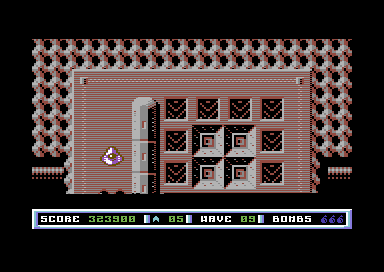
The game idea aims to similar to the original Spider Maze, but if you take a look at the snapshot below, you will notice that I made some improvements to the look and feel of the game. I also added a challenge to the game concept as well. There are the regular old features, where the player has to collect all the diamonds, whilst avoiding getting killed by the deadly spiders. The player can also pickup items to help or hinder. The bulb will charge the player up and make Fredrik invulnerable for a short period of time. However, he is not invulnerable against obstacles such as skulls. There is also the extra life heart, which can be collected on every 4th level. (Below you can see level 3's design)


New game features

There are also some new features blended into the game as well. The first are two collectibles. The first one represents the letter "B", which does nothing spectacular, it gives the player bonus points (Well 500 points to be honest). Also the second collectible implemented is a clock, which will either add or deduct time from the clock. This will remain a mystery to help or hinder Fredrik the Ball. Also if you take a look above, the score panel has a border around it. However the border will be animated and scroll around in order to make the panel more interesting. The panel has no flashing effects this time.

New deadly features for Poor Fredrick

There are some new deadly surprises implemented into the game as well. The first is that you have to race against the clock to complete each level. If the time runs out, the game ends. The second new surprise is that, not only will the player have to race against the clock and avoid the deadly skulls. The player also must make a safe path away from the deadly spikes (which starts on level 5) - even when invulnerable. This game is very cruel, but challenging, but the player will be starting with 5 lives.

If you take a look below, I have designed the first level (level 05 - not level 01), which features the deadly spikes. The spikes animate by rising and falling. The player can pass the spikes easily if a blank path is available.


My quick plan for Spider Maze 2


My plan for Spider Maze 2 is to feature 16 levels (I think the game perhaps could be hard enough with 16 levels). As you start each level, less time is available to complete it (by 200). The first 8 levels start with slow spiders, then levels 9-16 removes the drag rate of the spiders, forcing them to move the same speed as the player. The game aims to be more colourful and even more frantic compared to the previous Spider Maze.  

Other plans include making music and mixing sound effects with the in game music. I have not decided which music composer I will be using to make this new game, but it is likely that I could be using either GT Ultra V1.5.5 with SFX support or Electronic Music System V7.03 and code my customise sound effects. It is likely to be the first option, depending on time.


Target release date of the game

The release date aims to be some time in February 2026. This is not going to be a long game project, since the code from the first Spider Maze (Tutorial test version) is being adapted to this new game. Although I cannot give you a full date release when the game will be launched. The game will feature on my itch.io showcase when it is ready for release. Like all T.N.D games, Spider Maze 2 will be free to download and also an online web player version will be featured on my itch.io page.

Wednesday, 30 April 2025

How Repetition 64 was formed

 28th April 2025

During the winter of 2025, I had some time spare in the evenings to participate in the "Simon Basic" game jam run by Phaze101 and Retro Programmers Inside. The idea of the game was to create and develop a game suited for a retro computer or console which resembles the old classic type-in game "Simon Says". We know there were popular toys in the 1980s and 1990s called "Simon Says" or "Einstein". Let me explain more about the theory of the game.

"Simon Says" is a simple game, where you watch a sequence of lights (and listen to the sounds) played by the computer. After listening to the sound, your task is to repeat the sequence of the lights/sounds in the correct order. If you successfully completed the sequence you move on to the next round, where an extra light/sound is played. The game keeps playing on until you select a wrong note/light.

Well, being that I did not make anything for a very long time for the game Jam, due to either 1. the production idea was too difficult, 2. I didn't have enough time available and was very busy on another project. I decided to create my own entry for the game jam. There was a rule though. "The game must use any form of BASIC". I was allowed to use machine code, as long as I keep it minimal. The game that came to light was "Repetition 64".

A rough start

When I started working on "Repetition 64". The first thing I wanted to do was work on the basics of the game. I needed to have some sprites to prepare the buttons. I booted up CBMPRGStudio V4.5.0 to create sprites for the game project using the sprite editor. It was simply a square. Then afterwards, I exported the square sprite as pBASIC data. (pBASIC is an BASIC interpreter that uses labels rather than numbers, then after compiling, generates the listing using numbers. I hated working with line numbers, because I easily got myself lost. pBASIC on the other hand made life much easier).  Since a whole sprite consists of 64 sprites ($00-$3f) I needed to work out where to POKE the sprite data. So I POKE the data to $2000-$203f. (8192-8255). This was only for the first part of the project.


A touch of randomness

The next thing I had to do was think "how am I able to make the computer be able to play the notes at random?". This idea was fun, but I got round to a simple solution. It was to generate a for/next loop which generated a random set of numbers between 1 and 4 (using dice simulation RND functions) and then POKE the random number table TO $c000-$c0ff (49152 to 49407) inside the loop as 256 bytes in memory. 

Getting the computer to play the notes

The first thing I did was used CBMPRGStudio's built in SID editor to prepare the chords for each of the notes for the game. After I was happy with those, I exported them as GOSUB labels ready for the game to be able to play them. Of course I also had to create a loop that completely initialised the sounds.

The easy part was preparing the random numbers into memory (49152), the hardest part was getting the computer to play the random sequences. Apparently not, it wasn't that hard to be honest. All I had to do was create another for/next loop and PEEK each number from the random number sequence table. Then afterwards I checked if a marked variable matches the number of the random number, and then jump to a subroutine in the listing to play the correct colour and note. 

Getting the player to play the notes

A similar trick to computer playing the notes was made to get the player to play the notes and light up the correct squares. However, there was one trick I had to do to solve this trick and that was of course check if a wrong note was being played. If the variable stored from the player was played incorrectly then the program jumps to a subroutine that process a fail sound and then deducts one life from the player. Then loop to the computer playing the same sequence again. If the player got the sequence correct, then the level variable increments by one, and adds one extra sequence to the sequence play/read loop. The program can play a maximum of 255 sequences, but I highly doubt the player can do that.

Scoring and bonus

I made this game allow add 150 to the score variable for a correct note played, and if a whole sequence was completed, I added 1,000 points to the score variable. Also after eight levels were completed, I added an extra life to the lives variable.

Adding skill levels.

Having one skill level during game play was pretty much boring. I already had one slow speed set for an easy game. So, I created a variable set as a skill level, which was set if F1, F3, F5 or F7 was pressed. F1 set up the easy skill level, F3 set up normal, F5 set up hard and F7 set up the totally difficult setting. The skill levels were based on the speed of the playing time for each of the notes. After play testing through these in the main BASIC program, I was very pleased with what I did, I decided to work on presentation.

Presentation and music

I wanted to make Repetition 64 more presentable. This was so that the game focused more on the quality design, than being just a standard basic game with a plain black screen and 4 sprites with four colours. While designing the graphics, the custom made character sets and screens were designed first using Charpad V2.7.6 free edition. Then afterwards I started a new character set project in CBMPRGStudio and imported the graphics font and other data into memory. The reason being was because Charpad only allows limited attributes. I wanted to use both colour and screen RAM based on custom colour data, rather than character sets. After importing the character set and re-colouring the character screen for both the title screen and game screen. I exported both screen data and colour RAM as PETSCII graphics and exported the character set as BASIC into the project. After generating the whole BASIC program, I came across a snag, where the screen and colour data did not display in the correct row, and also the sprite data overlapped the BASIC listing also. 


I needed to solve this problem, quick and fast before running out of time. The solution was to keep the BASIC listing, but instead of using DATA statements and PETSCII screen layout listings, I decided to rely on creating some limited machine code. This had to be done for the sprites and the screen display. Also I wanted to add an interrupt to the title screen so that it can scroll text across the screen and also play some music I made in Goat Tracker Ultra V1.5.5. So I created some small routines to create an IRQ raster interrupt with scroll text and play music. To finish off, I tested the IRQs, screen display routines, etc (outside the BASIC listing) and used a M/C monitor on the Action Replay to convert the hexadecimal addresses to decimal SYS addresses. Then afterwards, I put the SYS addresses into the BASIC listing.


Making the Music

I had an old tune which was already released on the title screen. Since there was still a little bit of time, I decided to make some music exclusively for this game. This was made using Goat Tracker Ultra V1.5.5. The music had some 80s space disco sort of feeling, also featured echo lead sounds to definitely give out a space kind of effect. I feel that this could be one of my best tunes by far this year - but could I beat that in my next game C64 project later on this year? We will have to wait and see.

Putting the game together

So, then you may wonder how did this game get put together? Well, the rule for the competition was that the game MUST have a BASIC dialect and should also be runnable from BASIC. I followed that rule. However, putting the game together required two different builds. The first part was compiling the pBASIC listing into C64 BASIC (using CBMPRGStudio). Then afterwards, add an import binary command of the actual BASIC listing along with the machine code program, charset, sprites, the two screens and music (with a safety offset of two). This resulted to 116 blocks file size.

The finished release

I did two versions of the game. The first was the game jam version (The 116 blocks release), where everything remained uncrunched and was runnable from BASIC. The other version (featured on TND's itch.io page) features exactly the same game, but instead, the game was crunched the good old Public Domain tool, Time Cruncher V5.0 from 1988. I used the BASIC run (JMP $A659) command and $37 as $01 to set the BASIC listing to run the program after decrunching from memory. Finally I put the TND presentation linker on to the game, crunched again with Exomizer and everything was running nicely. The reason for why Exomizer's Exo BASIC wasn't used was because it wasn't compatible with the tape loader I used for the TAP version and crunched with TC V5, worked fine for me.


So how did the project turn out.

Development of Repetition 64 lasted a while, during the cold awful winter and the project went really well. If there were improvements made to this game, I probably would have added scrolling character graphics, like I did with a few of my games, add a custom option where you could play in cross mode as well as square. I probably would have moved the sprites around to increase more craziness for the player who plays it, but that could be "Rotor Repeat" later on this year, in order to mark the 25th anniversary since my first ever C64 release in September 1995 (Update: 11/01/2026 - Unfortunately Rotor Repeat did not happen, but I can confirm that the game idea is not cancelled.). However, I was developing towards a deadline, and decided to keep it pure and simple, but presentable at the end.

Where to get the game

The game was created specially for Retro Programmers Inside and Phaze101, but I have not supplied the whole project code publicly yet, in respect to the game jam rules. However, after the game jam has finished broadcasting, I have now uploaded the entire project onto my github page publiclyso that you can load it into CBMPRGStudio. You can find the code here:


https://github.com/RichardTND/Repetition64

You can download the Repetition 64 from my itch.io page which is via this link below:


https://richard-tnd.itch.io/repetition64


Sunday, 25 December 2022

2022 Reflections

It is that time, and for the very first time I thought it would be nice to reflect about the game-related releases of 2022, which I made. Warning – this is a very long post, but hopefully you should enjoy it and you may get some laughs out of it.

No SEUCK Compo in 2022

First of all, unlike previous years I did not launch the traditional Official C64 SEUCK Competition, this is because I decided to retire as host from the competition. A new organizer was found, and there was going to be one at the fall of 2022 but due to busy schedules and other reasons, the competition has been postponed to 2023. Merman is a good C64 enthusiast and a writer for Scene World and also runs the SEUCK Vault. He has been appointed as future host for the SEUCK Game development competition. When that will be we don't know, but if anything does happen then I'll post news about it on my TND web site.

SEUCK Enhancements

Looking back in 2022, I started the new year with a utility called the “SEUCK Title Screen Maker”. It was a fun utility that allowed you to create brand new title screens for standalone games that were constructed with the Shoot Em Up Construction Kit. Those who were bored with the old front ends were able to construct a game with an animated title screen full of colour, optional hi score table and also plenty of music. No code was needed to make a new front end, just access to a freezer cartridge like the Action Replay MK VI cartridge or VICE.


The easy part was developing the utility. The hardest part was writing the manual. I am usually not good at explaining things technical, etc. There was good feedback and improvement suggestions about the production, some of which got implemented (Multi tunes). I was really pleased with how the SEUCK Title Screen Maker turned out. A few people have actually used it. I know Vox Video Game used it for Diamond, and Mac of TUGCS used it to make his SEUCK creation, The SEUCK Camp.

The other SEUCK enhancement I did was a special tutorial of SEUCK School. A tutorial where you could make a new score panel for your SEUCK game, using 8 sprites in Rayfish. This was to be split into two parts, but unfortunately part 2 had to be postponed due to raster time issues and needing more investigation. Perhaps in the new year this will be solved.

That said, regarding enhancements. There was one unreleased game which was made for the delayed Reset 64, which I enhanced with a new front end and music. All will be revealed in issue 15 of Reset when it comes out.

... Now what about the games I have developed throughout 2022? Well, let's check them out!

Lane Crazy

The very first C64 game creation I wrote in 2022 (although I started it Christmas 2021) was a really fun creation. It is quite a memorable production. I know I had loads fun coding it in C64Studio, and for the game to appear on the Zzap! 64 Micro Action covermount was a real bonus.

I teamed up with Blazon and Friends to develop a really fun hi score survival challenge called Lane Crazy. The concept was quite original and turned out well amongst the crowd. You had four balls rolling down a vertical scrolling lane while holes appeared at random. You had to use either a joystick or keyboard to shift the balls left or right. If one ball fell through the hole, the game was over. There were 8 levels in which the player had to survive, where after two levels the game got much faster.


While developing this game, I was using some of the usual graphics tools, such as Charpad V2.7.6 free and Spritepad V2.0 BETA. Usually my graphics looked really rushed out. However the result of making the in game graphics turned out nice and smooth. There were separate void tiles specially made for each level. When I was programming the game, I made the code copy charsets that formed the void and placed it into the actual charset that formed the scrolling void. The rest of the scroll was a wrap-around scroll, apart from the holes that appeared on screen at random. The concept really worked. The hardest part was to get the smooth scroller working on NTSC, but at the end I managed it.

When I was composing music for this game, I decided to go oldschool and use DMC V4.0 on my Ultimate 64. The music for the game blended in quite nicely.

Lane Crazy was really great fun, and it was nice of Firelord, Logiker and Baracuda to have teamed up to help me bring out a quality production, which saw the light of day. A huge thank you to you all for helping me out with such a successful project. Maybe we can do another new game in the future.


Tasered in the Crotch

The next game (Ironically) I wrote was a little joke game. It was called Tasered in the Crotch. Despite the silly name, and it being inspired by Commodore Format Archive’s Twitter poll (Dick Tracey, Cisco Heat, Tasered in the Crotch). The majority of people voted to be Tasered in the Crotch. This gave me a funny idea for a game coded in C64Studio. It was a fun little shooting gallery style game.

You had police officers lined up on a high balcony (or maybe a scissor lift). They are armed with their new state of the art tasers. Your task was to command each officer to fire a taser at the bank robbers that were walking/running past. Some were armed with smoke bombs, and you had to defend your officers from being hit by a bomb. Also, you had to watch out for innocent civilians who were passing A bomb or tasering civilians resulted in a loss of a life. If the number of criminals escaped exceeded the quota set for each level, the game was lost.


The game design was yet again made in Charpad and Sprite Pad (Same version as before). I wanted to make a few different landscapes, but with the limited number of characters, I had to improvise. After importing into the game project in C64Studio. The code was in place, and the result looked really good.

It was great fun making this game, and the music (made in Goat Tracker V2.76), which was featured on the title screen sort of had an Ocean Loader inspired tune to it just after the introduction might sound quite familiar.

A game which was intended to be a joke turned out to be something much more playable and successful, compared to Dick Tracey and Cisco Heat - It also appeared on the Zzap! 64 Micro Action covermount and was quite popular amongst one particular video reviewer :)


Little Nippers and Little Nippers DX

Reset had launched a 4K game development competition. I wrote a fun little single button game in which later on become a full game production. Little Nippers was the game. It was a fun co-op production which I made in C64Studio. This was a single screen game, where naughty kids were running across the beach. There were buckets lined up and it was up to you to fire a crab out of the buckets in sequence, by using either the spacebar key or the fire button. The crabs then moved in a straight line and if you nipped a pesky kid, points would have been scored according to distance from the sea. If the crab entered the deep end of the water, it gets lost.


Although Little Nippers started as a 2022 4K game competition entry. However, with summer on its way, and the competition submission deadline had finished. I decided to team up with Hugues Poisseroux to make a full version specially for Zzap! Micro Action’s 9th covermount, before taking a break from it and focussing on finishing off one of my main game projects.

The new version of Little Nippers gave the player five different beach/seaside locations. Before you were able to complete each location, you had to complete eight levels. There were 40 levels in total. Also there was a fun incentive which was added to the game. You had a time limit to launch your crabs out of the buckets before they have enough and jump out. There was also an incentive where you could fling a jellyfish for more points. Little Nippers DX was a good highlight and it really turned out to be a fun and pretty much addictive game creation.

 
Hugues' loading bitmap really highlights how fun the game was to be, It highlights some of the elements that were featured in the game. A snappy crab, a jellyfish and also a bikini (or two). All of which blended into the all new version of TapeTool turbo loader.


TheC64 Coding Challenge - Poing Ultra

I joined the group, Retro Programmers Inside. It was a group of retro computing enthusiasts, who were learning to program games and other fun stuff. The group was run by Prince/Phaze101, and Retro Programmers Inside. They did weekly video casts which mainly involved coding tutorials and also run game jams. The challenge I participated in was the PONG challenge. The game was called Poing Ultra.

My challenge was to make a new retro game, which suited the PONG challenge. It was to mark 50 years of the classic arcade bat and ball game, PONG. I thought it would be fun to make my very own game using RGL’s theC64 full size computer. The game was constructed using various Public Domain utilities I owned back in the 1990s and also the previously commercial Multi-Screen Construction Kit, and Action Replay cartridge MKVI (plugin). Music was made in DMC V4.0, The music was mainly techno, trance style and it worked out pretty well in the music editor. The programming was done bare bones in Turbo Assembler / Turbo Macro Pro most of the time.


There were a few pitfalls I encountered while developing this game. Although the main game was fully complete and working well in the assembler. I should have programmed the title screen as a separate file. Instead, I used the same assembly file and run out of memory. It wasn’t a complete failure developing this game. I ported the code to 64TASS and finished off the production using the cross-development tool. The game graphics were then drawn in Face's FacePainter, and the result turned out quite nicely in the overall productions. Mastering was finished with Martin Piper's TapeTool V1.0.0.7


The game got submitted to Prince/Phaze101, who then later broadcasted the game live on his Twitch channel along with some other entries. He was very impressed with the game overall, especially the graphics and presentation. While I was watching the broadcast, I was very pleased with the overall result.

Slug VS Lettuce

I developed a new little game, as part of the Scene World feature “Let’s Make a C64 Game”. This time it was a 10 minutes survival challenge called Slug vs Lettuce. It was a little game in which was to teach the basics of making a single screen platform game using KickAssembler. You played a slug that has to jump from platform to platform, gobbling up the lettuce. The slug had to avoid getting washed out by the falling salt droplets.

The game graphics were designed using the usual cross-development platform tools. The music was made in Goat Tracker. The rest of the project was being made in VS Code, and KickAssembler via plugins. Although I liked KickAssembler, the one thing I least liked, during the development of this project were the nuisances that VS Code developed. Popup-tooltip, etc. Of course compiling the code was easy enough, a basic push of F6 on the compile target file, and then F5 to run it, but there were no possibilities of crunching it with Exomizer (or the brand new TS Crunch). Instead I had to just make a batch script file and execute that.

This game did not turn out too bad, and it was really fun to make in Kick Assembler. However, the hardest part was to get the jump and charset collision mechanics accurate. The good thing about it though, was that the game worked out really well.


My biggest C64 project - Cruiser-X 79 – finally finished and released

The majority of 2022 was spent on my main game project, Cruiser-X 79. I had waited too long for additional graphics and level maps. Unfortunately, I received nothing due to many busy periods which Saul had to go through. – That was until I thought about an alternative plan. I did promise to get Cruiser-X 79 finished in 2022 and I really wanted to do that. However, I wanted to try and make the job easier for Saul. So, I created some rough game graphics (which you saw in previous blog entries) and maps. Then I sent them over to Saul to improve. 

I also worked exceptionally hard on making level music in GoatTracker Ultra V1.2 and getting everything to work. Also, I was working to a deadline to get this game ready in time for the Christmas issue of Zzap! 64 Micro Action (Issue 11) and its covermount.


I did come across one major pitfall in getting the mighty big shoot ‘em up finished. That was handling the Covertbitops loader system and Exomizer level unpacking system. It took me quite a lot of attempts to finally get each level to unpack and run on the disk version of the game, and I managed it.  

I also wanted to do a multi-load tape version of the game. Martin Piper’s TapeTool was one option, but I chose Paul Hugues' Freeload at the end because it used less zero pages. Also, it did not affect the game code either. The overall result for both digital disk and tape version of Cruiser-X 79 turned out excellent. It felt like a full price commercial quality game production as you would have expected back in the late 1980s or early 1990s. It was also the very first time I ever made a huge multiload production - especially on tape as well as disk. I am really pleased with how Cruiser-X 79 turned out. The feedback was also good.


Snake VS Bomb

Now coming to the end of this year, I decided to end C64 development for 2022 with a bang. There was a competition that was run on CSDB called the “Snake Fun Compo”. The idea of the competition was to create and develop a demo, game or whatever was related to snake. Considering there have been many Snake clones launched (I specially did one as a theC64 challenge back in 2020 called the Forever Extending Hungry Snake). I wanted to make something completely different.


Hugues and I joined forces again to bring out a quality game production for the competition called Snake vs Bomb. Developed in CBMPRGStudio V4.0 with KickAssembler (and with less nuisances compared to VS Code), Snake vs Bomb was a vertical scrolling dodge and collect hi score challenge.

You played a snake that was slithering through a tunnel. Fruit and bombs appeared at random inside the tunnel. The snake had to eat the fruit but avoid the bombs – otherwise the game ends. As the game progressed, the speed of the game scroll increased levelling up in difficulty. The result turned out really nice, and no matter how simple the game was, it turned out great. The graphics and the loading screen artwork really polished the game. It was also my very last game for 2022.


… and that rounds up my productions I made in 2022. 2023 will be a tougher year, but I insist that new games will be made by me. There should be another theC64 programming challenge sometime (Where I make a production fully on RGL’s theC64), my SEUCK enhancements/tutorials and my editorial task of building Scene World will continue. Also, I aim to return to Unity and convert one of my year 2022 C64 games to the platform. Before I do that, I some books to go through. I look forward to seeing what can be achieved in 2023. Also 2022 is the year I finally realize how proud I am about myself, and my creativity - and may it continue throughout 2023.

If you would like to check out my releases (as mentioned in this lengthy blog) you can find these at:
https://richard-tnd.itch.io

I would like to wish you all a Merry Christmas and a Happy New Year

Wednesday, 3 August 2022

Cruiser-X 79: More bubbles

 Because I liked level 4 so much, and the bubbles scene. I decided that level 15 should feature the bubbles once more, but this time much inside a much harder level. There are some more barriers in which the ship should avoid crashing into, but as usual shields should be easy enough for the player to pick up. The shield allows the player to fly over deadly background for a temporary amount of time. 

On the music front, it is another fast paced tune, but not trance. The music sort of feels very oldschool like something you may have heard in the late 1980s or early 1990s. The idea for the music for this level was intended to sound a bit like Maniacs of Noise, but the tune plays too fast. I had to make the music fast due to the level finishing before the music loops back. The result is pretty good.

I exported Level 15 graphics into the game source. Re-configured and compiled the game to put everything in place. Then I set the game code to play level 15 after loading from disk and played the game with infinite lives. This rough level design has turned out quite well. I am really pleased with how it has turned out.


There is only one more level to design this week, before I go full on into the game code next week fixing the game bugs and adding additional elements like 'continue game', 'hi score/name entry', etc. There is one thing I am most certain about. That is completing the project in time for a Christmas release. There is still plenty of time for improvement and finishing everything off. - Unless of course circumstances beyond my control holds things back, which I hope will not be the case. :)

Sunday, 31 July 2022

Cruiser-X 79: A touch of glass

I am back in action working on Cruiser-X 79. The next level is once again based in space. I wanted to make another ice-themed level for this game. I loaded up level 6's map in Charpad V2, and created a brand new map from it before adjusting the character sets to make a rough design.

Well, Level 14 is still ice themed, but this time round, it is based in space, rather than inside the original base. I wanted to make some glass windows for the base, so that it looks as if it is some kind of glass-ice base. Also I adjusted some of the background charsets to make the base look slightly different. Yet again some more deadly obstacles with an incentive have been added. This time the obstacles/full blockade is a further distance than the shield. It is up to the player to pick up the shield and try to fly over the blockade otherwise the player will die.

After completing my rough design of the game map and altered the character graphics. I went onto working some music. This time, I decided to do a spacey themed tune. It is still up-tempo, but quite moody. In some parts of the tune, there is one part which reminds me of the theme tune to the 1980s TV show, Street Hawk. But of course the music in the game is definitely not that.

After finishing the music I exported all of the charset, tiles and map data into the project source code, and then compiled and run a new D64 with level 14 added. I am very pleased with how the music turned out during play of the game build. As for the game graphics, it is just temporary until they have been given the magic touch by Saul.


There are only 2 more levels for me to design before I go back to the game code and make some minor improvements. The project is shaping up really well. I am confident that this game will be finished and released some time this year.

Friday, 15 July 2022

Cruiser-X 79 vs Spore

 Well then, another week nearly over, and the rough graphics designs and maps I have been making are close to completion. Today I focused the mid morning - afternoon developing level 13 for Cruiser-X 79. The idea this time is based inside another base, which contains spore. The spore will not be deadly for the player ship, but there are to be quite a lot of obstacles for the player to watch out for, such as the usual high walls.

There isn't really much I can talk about, where it comes to this level. Except for that things look a bit messy at the moment. However S.C should hopefully be able to tidy things up with my rough level map design.

More music has been done for this game, and yet again another up tempo soundtrack, but this time more moody, but still trance like. 


Thursday, 14 July 2022

Cruiser-X 79 - Ultra Violet

 Wow, there has been quite a delay since I last did my last level design on Cruiser-X 79. Well, it was due to working between other game projects. I had the PONG jam, also Alf Yngve's Captain Ishtar project (Which is nearing to completion). Finally a secret game project I was working on for an upcoming covermount for Zzap! 64. Unfortunately the game project has been very problematic so close to the deadline. 

Anyway, moving on forward to Cruiser-X 79. This time it is level 12. It is also the return of the vegetation zone, but this time, I called it "Ultra Violet". This is because the game uses an ultra violet blue scheme instead of green. The idea sounds quite weird but the colour scheme has actually turned out quite good. Also yet again, the music for the game is trance music, similar to the style of level 5. I have added less walls for this level, as the enemies for this stage are getting quite harder and faster.


Saturday, 28 May 2022

Cruiser-X 79: Let's Rock !!!

Wow, am I really on to level 9 already? You betcha :). After completing level 8 last week. I worked on with designing level 9 on Thursday. I thought that for level 9, it would be nice to add a some new theme to the game. So an idea had come into my mind. The first half of the levels have been quite simple and involved shooting aliens and flying through bases, and hoping to avoid the enemy bases highest points.

Well, level 9's idea is similar to the first few levels, but I came up with an idea to implement even more deadly background. So that the player can easily crash into deadly terrain like rocks or similar - unless the player is carrying a protective shield (simply by hovering over the 'S' tiles). I started the level where there power ups are in place at the start of the game. Then I designed some of the background to make it look a bit like rocky terrain. It sort of uses some of the base's background character sets, and the deadly high building. I painted the blocks a little to make the deadly terrain look a bit like rocks. 

Although the graphics data that was being used for level 9 was based on level 4's Bubble World. This time round, I didn't want the bases to be bubbles based. I also didn't want the space background to become bubbles either. Instead, I chose to edit those character sets and turn those into steel saw disks. The colour scheme for the level are red, grey and light grey. The shoot-able blocks and other bits got transformed into different charset objects. After finishing the map and the design layout of level 9. I packed up everything ready for the next day.

The next day came, but sadly nothing happened that Friday. I was going to do some more work on the project on Friday, which was to work on some game music for the project. Sadly I felt unwell to be productive. Maybe tomorrow.

Saturday came by, I loaded up GoatTracker Ultra V1.2.0 to first work on some more in game music for Alf Yngve's Captain Ishtar project. Then I worked on level 9's music. It is sort of a dark, moody and industrial tune, which I felt would suit Level 9 of Cruiser-X 79. The tune is not trance this time (unlike levels 5, 7 and 8). I edited my instruments to make it sound right, then I exported the tune as SID and tested the tune. 

Once I was happy with the music, I exported it to PRG format into the game project's source code. Then I loaded up Charpad, and exported my Level 9 graphics and crunched them with Exomizer. I loaded up the source code, edited the settings and then compiled and built the project and tested the game in cheat mode. It looks pretty good. However, after Saul's magic touch to the graphics, it will look even better.

I am now going to take a short break on the level development of Cruiser-X 79. It is set to continue in about 2-3 week's time, unless theC64 challenge for Retro Programmers Inside's PONG challenge is finished and submitted to the compo. Stay tuned!!

To find out more about my progress with theC64 challenge #7 PONG 50th Anniversary game, please check out the link below:


https://tnd64.blogspot.com/2022/05/thec64-challenge-7-celebrating-50th.html


Wednesday, 25 May 2022

Cruiser-X 79: Lava hard work

 Last weekend I have been working on level 8, which is yet again based in space. However, I wanted to give the game a sort of a hot feeling. That's right. Level 8 is a lava base. I loaded up Charpad. I loaded up the graphics from Level 2. Then I cleared the whole screen and re-drawn the space background. Afterwards I placed in the tiles that formed the enemy base.

The next thing for me to do was to make sure that the level did not look too much like Level 2. So I edited the charset graphics and replaced some of those as new charsets. I tried experimenting with different looks for the enemy base. I decided to try and give it some hot look. I turned a few of the unused chars into plain chars, so that I could create a checkerboard effect. Also I altered the two scrolling charsets to represent the lava, which should parallax scroll with the game scene. A floor mosaic of an invader (with two high pillars) were implemented for the eyes. 

After completing my base, I worked on some music. This time, using the GoatTracker Ultra V1.2.0. Like with level 5, I thought it would be good to do an atmospheric fast thumping trance style tune for that level. I went for a traditional exotic mood inside the sound track. 

After finishing the music I exported all of the graphics data, and also imported the music into the game project source. I loaded up C64Studio and edited the level table and set the colour to match the level. The D64 building batch file got edited Then I compiled the project once more and run it to only load that level (I says level 1 on the status panel, but this is only test mode). The level loaded nicely, and the map turned out quite well.


Like with level 7, I have passed the graphics file to Saul to alter to make it look even more improved. I am very pleased with how things have turned out so far, and there is another level of Cruiser-X 79 (Level 9) I have in mind. It will be slightly easier on the game front, but there are harder aliens to come.


Saturday, 14 May 2022

Cruiser-X 79 - Shackled with Chains

 So far 6 levels were created and developed during this project. Now it was time for me to work on level 7 - Branded with Chains. Before watching some TV, I started on working on level 7 of Cruiser-X 79. Since the previous two levels were mainly based inside enemy bases/worlds. I decided to set this level back into space. Also I wanted to add some cool effect to the level as well.

The first thing I did for level 7. I loaded up level 2's data. Then I completely cleared the map (and saved it as level 7, just in case I saved the file incorrectly as level 2). I then set the colour scheme and set up the stars and planets (Which after Saul's update, I hope to be spiral galaxies). The project got saved again and it was time to watch some TV. 

The next day I loaded up the project, and I worked on making level 7's graphics. While doing this, I was listening to some music on Deepsid throughout. I designed the base layout, and constructed some large and also small chains. The large chains have been set to be static, and the small chains have been set at the scrolling chars. This is to give a good visual, when the lower chains are inside a shaft or between the two large chains. I also added a bit of branding to the game as well. That's right 'TND' has been embedded on some of the bases. I saved all the work.

Next I loaded up Goat Tracker and I worked on the in game music. Although the game consists of chains and things like that. I wanted to so something like a moderate speed up-tempo soundtrack to suit the game's level. After listening to tunes from Fairlight demos during developing the graphics. I thought that type of style of music might be ideal for the game. I worked on the sound tracks for a couple of hours or so, and came out with a masterpiece. I saved the piece of music.

I went back to Charpad to export the map, charset and tiles data to my C64 Studio project. Then I loaded up C64 Studio and edited the level colour table to match my Charpad file. Then built the batch file, so that level 7's music and graphics data gets compressed. Then test run the level. It looked great. Everything unpacked fine and at the correct colour. The music blended in well with the game, but I think I made the tune too long. It didn't finish when near to the end of the level. I think the intro of the tune could be tool long, so I might just remove the intro when I come back to the music perhaps next week. Still, I am pretty pleased with the result of Level 7.


Wednesday, 14 April 2021

Cruiser-X 79 - April Update #1

14th April 2021  

Previous update was deleted along with the Para Lander DX blog entry. This entry from 3rd April  is what has been remembered from that day.

3rd April 2021

Last time I was dealing with alien patterns. The next task was to put these into levels. I also was setting up the colour settings for each level table. Of course, last time all aliens were put into order of sequence and were being tested.

That week (for this part in the development) I mainly focused on the level alien attack patterns. Instead of all aliens being in sequence 0-40. I setup alien selection tables for each level. The idea was to ensure that each table has a specific level of difficulty. There are 40 different alien tables (some of which are duplicated enemies doing different things). The idea is that the harder faster enemies get used after a few levels. There are 16 levels in total.

Now that all the alien patterns are in place for each level. There is not really much I can do to the game right now. Although I will need to work on doing different tunes for each level of the game. 16 different tunes might be too many to compose, so maybe I do a few tunes and then create a table to load specific music files. Still, that will do for now :)


Tuesday, 13 April 2021

theC64 Challenege #6 Para Lander DX - Part 2/3

 1st April - 13th April 2021 (Continued)

Last time in my blog I mentioned about the Para Lander Mini, and also how I thought the game was finished. Things did not really go according to plan. In this next part, this is where I decided to stick to 64tass instead of using Turbo Macro Pro. 


Last time

I prepared, designed and developed an enhanced edition of Para Lander DX on theC64 with aid of an Action Replay cartridge plugin, some C64 applications, including Turbo Macro Pro. I worked my socks off on the game project and finally came out with a working game. However things did not turn out how I expected. Although I had a fully working title screen, hi-score table and game. There were some elements missing in the game. So here is what happened.

A new intro - Nice

Friday last week I ended up with a new picture for a TND intro by Hugues. I worked on programming it, added a Future Composer soundtrack, and the result turned out great. I then packed and crunched the game with the Sledge Hammer II and Cruel Cruncher V2.5+ to continue with the old-school theme. Then I wrote the game documentation. Unfortunately however the game was still not ready to release. So it was back to the game code once more.

Random situation

The game was working out quite well, but the main problem was the game play. The zeppelins were moving slow across the screen but the game was just too easy to play. I decided to create a random table of speed and I set random speed timers and pointers to the zeppelins. Unfortunately however I was unable to continue using Turbo Macro Pro as once again, the bottom area of the screen messed up and this time it crashed. This de-motivated me more from using Turbo Macro Pro for this game. I must have used all the memory perhaps?

As a drastic measure I decided to from now with the project use the 64tass on my PC. I created the random tables, generated them and compiled the game (and crunched it with Exomizer) and run the game in VICE. It was working quite nicely. After I completed the first round, Zeppelins randomly changed their speed. I came across another issue. The zeppelins were going past too fast. 

This resulted to only setting the speed of the zeppelin to the slowest speed, and play with the drag rates, between 0 and 3. After compiling and sharing the build with Hugues and another tester. They felt that the game would be better off using levels. So ...

Rank up

I felt there was something missing in the hi-score display. The title and game have music, but the hi-score display re-uses the title music. I felt that there should be at least one more tune for the game. For this, I decided to browse through the HVSC under my name, and I found a tune I feel that would have been great for the high score table. Feel Great. As a bonus this tune was also composed in DMC V4.0. I relocated the music to $8000, and placed it into the game project c64 folder and re-built the source. It worked. Excellent.

Level up

Random zeppelins in the game code didn't really work out, so it was time to make levels. Actually that was pretty much simple. I deleted all of the random tables and I entered the drag speed value for each level. The table for each zeppelin's drag rate was 16 bytes. The drag rate was still set between 0-3. Although setting the drag rate of 3 to 2 sort of looks as if the zeppelins are moving at the same speed, but in fact the speed is actually set to faster. After setting up the last level the game should loop. I then re-linked the game to the TND intro and prepared for a release candidate on my Ultimate 64. Yet again I used the native C64 tools to pack and crunch the game, like it would have been back in the 1990's. I then sent the game to testers. Some bad news - there were still bugs.

Stop bugging me

I decided at the end that I'll just stick to using 64TASS and Exomizer for all the packing and linking of this project, but I can disguise it to look like some of the old memorable packers . This saves me having to mess about all the time using old packers and crunchers just for the sake of old-school - then finding out something else gone wrong with this project.

The bugs in the game were that the hi score name entry routine allowed unwanted characters, which made a mess in the name entry. This was supposed to allow alpha-numeric characters, delete, space bar and return keys only It turned out I had set an incorrect range value (perhaps a typo) that read from number 0 and all the PETSCII character code before shift+A. Pah!

The second bug was that the total number of levels = 15 instead of 16 before looping back to 01. I set an incorrect value in the level compare code. It should have read 17 as the max value instead of 16, otherwise it would have been 15 levels. I re-compiled the source and fed the project through Exomizer, and after a few seconds, the game was working. The game has now been sent to the testers. Hopefully this could be a better result. We'll have to wait and see.


Update: Still not ready yet, but nearly there. Fingers crossed ;)

Saturday, 27 March 2021

March 2021 Cruiser-X Progress Update #2

 27th March 2021

A couple of weeks ago I had left you with where I last left off. It was mainly based on the power ups based system. Now 2 weeks later, more work gets done. Last week, I finished off fixing the SEUCK Title Screen Maker disk, by fixing a bug in one of the example games (Which wasn't the fault of the title screen maker).

This session was mainly based on level setup. Of course I may not have the level graphics yet for level packing, etc. First I have to set up different sound effects for each bullet type the player carries.


I can still start on setting up the level scheme and enemy selection. Last time I managed to get all enemies to appear in order of sequence. Today I have been making a sequence for level 1 of the game. This is now based on the colour scheme table read, and also the alien selection table (based on levels).

After setting up the level routines, the enemies are able to fire bullets but the bullets do not collide into the player. So in order to fix this, a subroutine is programmed in to read the X, Y co-ordinate range of both sprites, and if inside the collision area. The player will die, unless a shield is in place. Then the player respawns.

Well, that looks good, but not really good enough. When shooting at aliens or shooting destructable background characters, The player should score points. A subroutine reads pointers for the player's score, lives and level. Then it copies it to the score panel on screen. I decided to do it this way this time round, because it is a way to prevent the player cheating by freezing the game with the Action Replay cartridge and editing the score/lives value with the screen editor. I cannot code protection routines, plus I cannot be bothered with those anyway :)

The enemy scoring should be based on the enemy sequence value that is used. I set a new table which creates the new score values for each alien, after it has been shot. The values are based as 1-5. Where 500 points is the maximum score which the player can score. Shooting background and collecting power ups also gives the player some points.So can the activation of the player's smart bomb (Which is triggered with the fire button).

The player's lives indicator also needed to be updated to decrement, and when lives have reached 00, the player will lose the game, and GAME OVER commences. Of course even if I was updating score, lives and level pointers (or restarting the game) I would need to update the score panel via a subroutine.  I am happy that it all seems to be working.

Now on to one final problem. The alien spawn sequence is set based on the chosen level, the enemy bullet can now kill the player, the score panel is working. The final problem for today - the aliens are firing too rapidly. How can that be solved? Simple, before randomly selecting the enemy to shoot a bullet. A delay pointer, and delay expiry counter should be set. Adding one of those makes the enemy fire bullets less rapidly. There is a chance I could make a table like with the scoring table, where I could base the enemy firing rate. That might be some time next weekend. We will have to wait and see. But for now, here's an updated video of my work in progress.


Tuesday, 26 May 2020

Cruiser-X 79 Update

1st May - 26th May 2016

While things have looked very quiet on this project. It doesn't mean that we are not continuing with the game project. In fact, the hardest part of the game code is practically out of the way. There are 16 alien formation tables set up so far, but there's still more to go. For the time being I have decided to leave the additional alien group property tables for the time being and focus on trying to get the main game engine repaired.

The aliens were unable to shoot at the time, and I tried to re-install the alien firing. However because I had deleted a lot of the old code (as I assumed it wasn't necessary) C64Studio processed loads of errors. I looked through the code, and tried to work a way round fixing the error result. Good news is that I managed to find the result. I re-created the enemy firing routine, selected the aliens to fire at random (via a pointer and value selector). If the alien was alive, the pointer and the bullet was out of the screen.

After fixing the alien firing I decided to fiddle about with the front end a little more. I added a flashing effect to the game's title screen. Also a page flip routine was added in order to flip between the front end credits and also the high score table. The result turned out pretty good.

Next the main game. The aliens were originally spawning in sequence. However, I didn't want the alien groups to spawn in order of the values 1 -17, so I setup the level pointers and some custom sequence tables to get the aliens spawning in a chosen value for that particular level. The video below shows you how the feature results during game play.


Update 11/09/2020: I just want to let you know that this game has NOT been cancelled. At the moment, I am stuck in a loop where on the coding side, I cannot really continue until the new set of level graphics come in. This project is therefore currently frozen until further notice.

Tuesday, 4 June 2019

Cruiser X-79 - Migrating to another base

2nd-3rd June 2019

Sunday, I came home and was wondering what I should do. I decided on doing some more work on Cruiser-X 79. I decided to carefully look at the code, and copy/paste it it from CBMPRGStudio to Endurion's C64Studio. I created a new C64Studio project and called it CruiserX79_2019 and copied and pasted the necessary files. Then afterwards, the hard work was to be done. I had to rename commands to match the ACME syntax. This took about an hour of my time. Then there was the correcting of syntax errors. The labels were mixed case. So I had to relabel those. The errors were then fixed. I compiled, compressed (with Exomizer) and then run the program. The game title screen was running perfectly, but when it come to starting the game. It crashed. I investigated the problem. The culprit was - an incorrect music file was copied. So I corrected this by copying the correct in-game music file and placed it into the bin folder. The game now worked.

While I was testing the migrated build of Cruiser-X 79. I had come across a nasty bug, which I came across a long while ago. The bug was pretty much unknown to me at the time. The issue was where after the player had lost a life. When the shield had run out, the player exploded straight away, without even hitting an enemy, bullet or deadly background. I investigating further into this bug and I found the main culprit that caused it. That was the player death and shield code. After the player was killed by an enemy a pointer PlayerIsDead is set as 1, indicating that the player explodes. All I needed to do was initialize the PlayerIsDead to zero. So that every time the player's shield is activated, the player should not be dead. That is of course until an alien or deadly background hits the player.

I'm happy very happy to present you with the result and show you a video of the game in action, with a vertical scrolling test map, with all collision working in place. I deliberately set the game into cheat mode, so that you can see that I have indeed fixed the nasty bug. Although there are still one or two minor bugs inside the game preview. Nothing too serious though. Enjoy!


Sunday, 20 January 2019

Cruising for a Bruising

20th January 2019 

Well, 2018 sure has been a bit of a roller coaster of a ride, where C64 productivity and time was concerned. I mainly have been busy on SEUCK projects, but finally I have got time to do what I want. I will be on an Assemble It tutorial game project later on this week, but today I decided to concentrate a bit more on Cruiser-X 79. 

So then, what has been done today?. Before launching the playable preview, I have been doing a little more design to the test game map, which Saul originally did. This was mainly because the map looked pretty much plain space after about a quarter of the game map was drawn. So I decided to add some more tiles into the game's map and I tried to make it look as cool as I could. As soon as I finished with the map, it was time for me to export it to the game project.

Next was to load up the CBM PRG Studio and tweak some of the game code. There were some bugs inside the game, where sprites could be visible in the black lines between the game screen and the score panel. I simply fixed this issue by moving a subroutine which masked blank sprites into that particular screen area. After re-compiling the game, I could see my trick was working.

The next trick to was deal with the main game engine. I found that while playing this game, the player ship was just moving way too fast. The player was able to crash into the aliens or the deadly background too quickly. So I reduced the X, and Y speed of the player, so that it was moving at the slowest X speed and the Y speed is near enough to the correct X speed of the player.

Following that, I wanted to tweak the power ups slightly. There are 3 different tiles, marked B, M and S. The B tile is the smart bomb, M is the missile upgrade, and S is the shield. I wanted to make some alterations to the smart bomb and the missile. I started with the missile. The player's missile did work, but shouldn't the player have to pay the penalty for a cost of a life?. I altered the life lost code, so that then the player's missile was set to default - every time the player dies and fires the next bullet when spawned again.

The Smart Bomb feature was the next for me to enhance. Last time (originally) the smart bomb had a bug in the code, in which while a batch of aliens were being destroyed. Half a batch visible may have destroyed, but other alien sprites of the same group appeared. This just didn't look good for me. So I decided to do something about it. I added a trick which was to explode all of the aliens in one go. This was done simply by setting the code to enable all aliens, and make them dead straight away.

While still working on the Smart Bomb feature. I felt that the smart bomb code should be changed. So I altered the feature by adding some flashing background, to indicate the explosion. Also the feature was better off not being automatic, but manual. So I added a new subroutine and pointer where the player checks for the bomb carried. If carried, the Space Bar key activates the smart bomb feature, which destroys all or spawning aliens and awards the player 500 points.

The player has a penalty feature. If the smart bomb is carried, and the player loses a life, it loses the smart bomb power up, as well as the bullet power up.

I was going to launch a playable preview of this game on to the TND web site today, but I have decided to postpone it, due to a weird collision bug that is in place in the main game's code. The sprite/sprite collision code needs to be re-written from scratch, and some of the code needs to be inside macros. Once this has been dealt with, a playable demo of the game will be launched on to TND. Watch this space.

Saturday, 21 April 2018

theC64 Mini Weekend dev challenge #1

20th-21st April 2018

A couple of weeks ago, I bought myself a theC64 mini console, and I loved it. The built in games were cool. However I needed to purchase a USB keyboard, so this week I did exactly that. Set up a multi-USB adapter with the C64Mini (An old one) and everything was working. I was able to play multiple games from a .D64 (D82 image renamed to .d64). Now I realized. Wouldn't it be cool if I set myself a Dev challenge. Announced on theC64 Mini Users Group. I decided to set myself an assembly programming challenge.

CHALLENGE #1 - OLDSCHOOL INTRO

20th April 2018

I set myself a challenge, which was to create and develop my very own oldschool cracktro style intro using theC64 Mini. I was able to select some of the classic public domain utilities, that were released by the C64 demoscene back in the good old C64 scene days, and get those on to a D82 image (via dir master). Then I renamed the .D82 to 'theC64-drive8.d64' using my 1541Ultimate 2. Now it was time for me to get to work.

The Logo:

In order for me to design the logo. I went for a very classic utility from the 1980's called Centauri Logo Editor (Pictured below). I wanted to draw my own logo for this challenge. I went for an oldschool design idea. The idea was simply to draw a logo that was embossed inside a plaque. I got a bit carried away with the logo design, and pixed inside the words TND some stars and basic shading. Of course the logo was limited to 3 colours. After finishing the logo, I converted the Hires/Multicolour bitmap into a Font+Screen matrix format and the saved the font+screen files separately.


The Charset:

I wanted to create two character sets for the intro. They were 1x1 hires and 2x2 multicolour. I loaded in Shape's Font Editor V3.0. There was no joystick function for designing the font, so I used the USB keyboard to pixel the correct colours into the correct position in the grid. I was very happy with the 2x2 charset, the same for the 1x1 charset. Not a bad result.

The Music:

Now that I was 100% happy with the graphics. I got started on composing some music. For this I used Graffity's DMC V4.0 (Pictured below). I found it quite awkward to work out the key-mapping on the USB keyboard at first, but managed to get around it afterwards. The tune was to sound oldschool in a sort of Future Composer kind of way. I decided not to use FC, due to the possibility of the program crashing should DUR/SND be in the wrong place. I would not have been able to get back to the music editor if it did crash. I created some oldschool instruments using DMC's sound and filter editor. A little further experimenting came out before coming out with a final piece of music, called Laser Light. I was very pleased with the result.

The Sprites: I originally chose Shape's Sprite Editor V1.7, but after creating some star sprites for the intro. I realised it was just impossible for me to save the sprites. There was no save option implemented. So I decided to use  Graphic Editor, also by Shape. I created a series of sprite frames for the animated stars. Then saved everything

Coding/Linking:

Before I was able to do some programming. I needed to work out where I should place data and code. In order for me to complete my task. First however, I needed to use a M/C monitor, for loading/saving data during the coding process. I loaded up Black/Angel's improved version of Omicron's Turbo Assembler from the filebrowser menu then added a JMP $FCE2. This forced the C64 to do a soft reset. I was then able to load in the Code Suck Monitor into $5000 (Since my intro was intended to be only use data+code from $0c00-$4500 - where $4500 is where linked programs will go). I set CSM to load the following data to the following addresses in memory:

- Music: $1000-$1fff
- Logo Charset: $2000-$2800
- Logo Matrix: $0C00-$0e00
- 1x1 Charset: $2800-$2a00 ($2a00-$2c00 reserved for the star field source)
- Sprite anim frames: $2c00-$2fff
- 2x2 Charset: $3000-$3800


I went back to the turbo assembler by calling J 9000 in CSM. Then I programmed my own text routine, for writing the intro text, and also the scroll text. The intro text was placed at $3c00, and the scroll text was placed at $3800. Now it was time to code the main intro.

So then what was done in the main intro code. Well, for a start off, I needed to program an IRQ interrupt to ensure that music was okay and in working order. Then, I started to add more and pieces of code, and placing those together with the assembler. Basically, create a subroutine that displayed the text, logo and scroller charset using the default PETSCII. After I was happy with the result. Some more raster splits were added inside the code. One of which was to display the logo charset+screen, the presentation lines charset, and the 2x2 scroll text - and get everything smooth running. A good result.

Although everything displayed nicely. I felt that the intro looked too plan. So I decided to code a few raster colour bars. They got displayed, but the rasters needed timing out. Although I always had difficulties with raster timing, when coding intros/demos - I had no problem with this one. All 3 rasters were nicely timed out on PAL machines. It was getting late, so I decided to create a save state of the intro (as well as save the intro data + code done so far).

21st April 2018

More coding:

Last night I was very happy with the result of the intro, so far made on my theC64 Mini. Now it was time for me to add a bit of code to the intro. I felt that the presentation lines were just too plain. There needed to be something behind the text. So I decided to create an additional table which produced 6 characters for a flying star field. I put the star field into place. Added a little more code that could flash the text, and avoid the starfield from also flashing. Then I added the flying sprites and code. A final result. Finally the main code has finished. It was time to code a relocator subroutine then put everything together using the save option in CSM. (s "introfinal",8,0c00,4500)


Compression:

The intro (pictured) was complete, but there was one more thing I needed to do. Compile and compress the final intro, so that it was runnable from BASIC. Since I wanted to do things sort of late 1980's/Early 1990's style. I loaded up Compactor/Linker V4S by E.C.A Industries, a very old packer/linker, which did its job fine on my intro. Then to finish it off. S&T's 2mhz Time Crunch V5.0. The final intro was made and it all worked out quite nicely.

My weekend challenge of programming on theC64 Mini was very successful. :) I was very pleases with my result.

Want to see the intro? Download it from here, and place on to a USB Stick on your theC64 Mini and enjoy. I have also provided the Public Domain utilities that helped support me producing this production so you can see how the intro was made and put together. This intro can also be run on WinVice, and CCS64. Enjoy :)


Fredrik the Ball is Back: Spider Maze 2 in progress

  11th January 2026 First of all, a belated Happy New Year to all C64 and retro kind.   At last, a new blog update and a new C64 project is ...